Using Science to Understand Five Elements Theory

[youtube]http://www.youtube.com/watch?v=ITpDrdtGAmo[/youtube]

I saw this video of Richard Feynman explaining the physics and chemistry behind fire on Diane Kern’s blog and just had to share it. I don’t think most people understand that a scientific style of observation is the foundation of practicing Feng Shui.

Feng Shui, Chinese Astrology and other components of Chinese Metaphysics are becoming easier to understand and explain as science reveals what is really going on around us. You don’t have to believe in chemistry and physics in order to be able start a fire. You don’t have to believe in gravity for it to hold you down. You don’t have to believe in Feng Shui either but it is still affecting you.

Feng Shui for Gardeners 2011 : Year of the Metal Rabbit

On February 4th, 2011 we will enter the year of the Metal Rabbit or Xin Mao.  Some also call it the year of the Golden Rabbit. It’s fun to talk about the Chinese Zodiac and what animal represents your birth year, but did you know that the animals of the Chinese Zodiac are actually terms that were assigned to describe a particular type of energy?  It’s true. Darn, there go those generalizations about people born in the year of (your least favorite animal here).

During the Metal Rabbit year the Tai Sui is, of course, Mao or Rabbit. The Sui Po is You or Rooster. They are directly opposed to each other with Mao representing a Wood type of qi and You representing a Metal type of qi. In terms of five elements their interaction will break down the wood energy and weaken the metal qi. In this particular combination, we will see events similar to those of 2010 such as unusual and unpredictable weather and natural events, bankruptcies and civil unrest. Whatever you do, don’t use these predictions as an excuse to give up on 2011. Keep studying and working and you will be fine in the long run.

Now, for all you gardeners out there here’s the most important stuff:

For 2011 you need to avoid digging in the following areas: E, W, SW and NW. Disturbing the earth energy in these areas will bring bad luck and problems to the household.

Imagine a grid superimposed on your lot that divides the lot into 9 sectors. Use a compass to determine which sector corresponds with the compass directions, i.e. N, NW, W, SW, S, SE, E, NE. You don’t have to be exact, you just need to know where the areas are in general so that you know what to avoid. It’s okay to keep these areas weeded and cleaned up but don’t dig.

Don’t kid yourself that you can have someone else do the work and avoid the effects of awakening the sleeping gods. The person who creates the energetic disturbance will be most affected but there will be consequences for any residents of the house as well.

Each area on the grid represents a type of energy but also a family member. For example the outdoor position of Rabbit or Mao (E) represents the middle daughter, so if that area is disturbed it will have the strongest effect on the middle daughter, females, tween/teen females, or anyone born in a Rabbit year (1939, 1951, 1963, 1975, 1987, 1999, 2011, 2023).

Using Feng Shui to Grow a Lemon Tree

You might be asking yourself what a lemon tree has to do with Feng Shui. My Feng Shui practice is inspired and informed by my garden. Living in the Pacific Northwest I have learned that you can grow just about anything in your garden as long as you find the right spot for it. If you study Feng Shui you understand that this is the same for people. What is good is relative to the particular needs of that plant or person. If placed correctly they will thrive.

I have always wanted to have a Meyer lemon tree in my garden. The sight and smell are a lovely reminder of the lemon tree my Grandma ‘Tona had by the back door of her house. Most people will tell you that maybe you can grow a lemon tree in the PNW, but you will need to keep it in a pot and bring it indoors in the winter. Being the stubborn kind of person I am, I took this as a challenge. I killed 4 small lemon trees before I finally found the right spot for one that is now in its second year in the front yard. Not being satisfied with that experiment, I planted two more that are now blooming. I’m still not taking it for granted that I will ever get any lemons, but even if it’s just the scented blooms and the sight I’ll be satisfied. In nature it is easy to see the cycle of yin and yang and accept it, knowing that there will be a spring to follow winter, or the sweet relief of fall after harvest time.

There is no perfect Feng Shui, not even in the most lovingly tended garden of the most knowledgeable gardener on earth. But that’s okay. We don’t need perfect Feng Shui to be happy in life. All we need is to understand the environment we are living in and its influence on us, study, work hard, do good in the world, and make the best choices we possibly can. And of course lots of time to do gardening.

It’s risky to try to grow a lemon tree outdoors and in the ground in the PNW. If you listen to everyone’s advice, you won’t even try. Would you like to try to achieve something that no one thinks you can do? Using Feng Shui lets me put you in the right place so that you can succeed in your endeavors – just like the lemon tree. Find the right spot for you and do the unexpected.

It’s All About Me (or You)

A teacher of Chinese Metaphysics I once studied with said something that has become a guiding factor of my study and practice of Feng Shui:  It’s all about me!

What she meant was that when your goal is to create the best balance of energy in a space you should orient everything based on your specific needs in that specific time in that specific situation. When you are the client, for your consultant it’s all about you and your relationship to the qi.  There is no general rule to apply for every situation.  For example, a bed in the master bedroom of a healthy 40-something CEO would probably not be placed properly in a corner but there are some adults who may benefit from placing the bed in the corner.

Each of us exists in a complex web of relationships with our environment and the people in our lives.  It’s useless to try to make generalizations about someone’s situation.  It does not happen that one consultation is exactly like another, although it is possible to apply something you learned to multiple situations. This is why when you describe a situation you may have encountered to your Feng Shui teacher and ask “Is that okay?” he or she will tell you “It depends…”.  The question can’t be answered without knowing all of the specifics.

Even if you gave a thorough description of the audit including birth information, photos, a qi map, a report, etc. to a Feng Shui consultant, in reality he or she is not able to accurately assess a site without going there, looking around, and meeting the people or person who hired him or her.  A consultant is like a CSI gathering evidence at a site to take back to the lab in order to study it and understand the story of the crime.  Although there can be copycat crimes, there is some detail or characteristic that makes each crime unlike any other.  The same is true of houses.  If everyone on your block is facing the same direction and has the exact same house plan, the same lot size and shape, the same grade to the land, that doesn’t mean you will all lead identical lives.

I know Feng Shui works.  You don’t need to believe in it.  I want more people to be able to enjoy the benefits of it and feel like it was worth the price they paid their consultant. Don’t believe people who say they can do “remote consultations” or who practice some “one-size-fits-all” method they learned from a book.  It’s simply not true.

The Freeing Power of Failure

I just had to share this article I read in the NY Times this morning about 81 year old Joan Dye Gussow.  Where do I begin?

I’m inspired by the life choices she has made and the way she has educated herself.  I’m inspired by the thought of being 81 and still able to lug around some bags of topsoil, but also having an elegance in knowing my own limits.

I have always known I don’t fully appreciate and understand the life-giving qualities of “destruction” – even after all this time studying Feng Shui.  I see the expression of this natural cycle every day when I look at the Tai Ji and tell myself I understand it, but it is in the garden where I’m finally getting it on a gut level.

Losing a tree, plant, or an entire garden is an opportunity to start over and make it what you really wanted this time.

My House Has Bad Feng Shui!

I’d like to share a story with you. The events in the story happened prior to my completion of my Foundation Studies in Traditional Chinese Feng Shui.

No one is happy to hear that their house has Feng Shui issues. I know I wasn’t pleased when a teacher explained to me how it was difficult for qi to make it into my house and, how it was too easy for qi to leave.  There is nothing mystical about the explanation for this, it simply has to do with Land Form.  The slope of the land, and living on the corner of the street on an elevated lot are only three factors in a list of Land Form issues that my house has. She also commented that the situation was “unstable”, in part due to the unevenness of the overgrown terrain, deck, porch and house.  There were too many different levels for the qi to flow smoothly.  I have to say from experience that she was right and I was especially crushed because we had just purchased the house about six weeks prior to her visit.  Site selection is the most effective way to make sure you have a Land Form that works for you and I have learned my lesson.

This is where being a stubborn person came into play and I realized that even if I could never fully correct the problems I could at least use my knowledge to have some influence over the situation.  Since then we have made quite a few changes to the entries and exits to the property as well as the landscape – all in an effort to receive and hold the qi better.  If you saw my lot and landscape changing you would never have guessed that Feng Shui was the driving factor of the design.  Authentic Feng Shui methods are not obvious or even noticeable to non-practitioners.  I want the garden and lot to be beautiful, the same as a designer would but I am going for something more.  Each plant must be not only thriving where it is placed (in terms of sun, shade, moist soil or dry, etc), it must also be helping to circulate or hold qi.  I know I can’t change the Form, but I can do small things to improve the situation.

So that leaves the question – what do you do if your house has bad Feng Shui?  Obviously you can hire a Feng Shui consultant to help you, but if you already have issues with Form you probably don’t have a lot of money to spend on Feng Shui.  Here’s some information that really helped me to stop worrying and do something about my situation.

In China from roughly 605 AD-1905, there were imperial examinations that were required for those who aspired to become a government official.  Passing the examinations (or not) had a profound effect on your status in the society, your family and your future prospects. Of course everyone wanted to pass the examination and worked hard to prepare.  I’m sure one thing that they worried about was Feng Shui and its influence on their success.

Scholar and astrologer of the Song Dynasty Su Tong Po was asked about the factors affecting someone who wants to pass the examinations.  He explained that there are 5 factors that would help anyone to succeed.  The five factors are Destiny, Luck, Feng Shui, Study, and Doing good deeds.  The Destiny and Luck are givens –  controlled by Heaven Qi, Feng Shui influence comes from Earth Qi, and study and doing good deeds are under the power of humans.  It is free will that lets us decide how much we study, how hard we work, and how many good deeds we will do.

If you are worried about your Feng Shui you can at least do your best in those things that are under the power of humans:  Study and work hard.  Do good deeds.  Remember that you can change things – sometimes just by changing what you choose to do.

See the Chi

If you are a student of Feng Shui, then you will see opportunities everywhere to further your learning.  If you are a student of Feng Shui who enjoys food and cooking, you start to think about food in terms of energy and qi.  A simple shopping trip becomes a lesson in selecting the produce that has the most qi left in it.  In the grocery store, this means looking through the heaps of apples and being able to see the ones that have retained the most energy, or to put it another way, which ones are the freshest.  If you practice, you will learn to see that some apples seem to have a little glow about them, their color is a little more vivid, and they stand out among the others. If you really pay attention to your five senses you will become good at this.  If you would  like a more extreme example, think of the difference between canned spinach (ugh!) and fresh spinach.

The people you identify as “really good cooks” are the people who look for and use the best and freshest ingredients.  If you start out with ingredients that still have a lot of the energy they had while still growing and alive, you are pretty much guaranteed a great result.

“When you have the best and tastiest ingredients, you can cook very simply and the food will be extraordinary because it tastes like what it is.” (Alice Waters, The Art of Simple Food, p.3)

When people mention the best fish they ever ate, it is often in the context of camping or fishing, and the fish they are eating is the one they just caught some hours ago.

There is no need for fancy sauces and spices because the fish is so fresh and full of life that it is deliciously satisfying on its own.  Lengthy preparation methods and racks full of seasonings are simply unnecessary.

I’m convinced that the underlying principles of good cooking are the same everywhere.  These principles have less to do with recipes and techniques than they do with gathering good ingredients, which for me is the essence of cooking.  Whenever I give cooking demonstrations, I put everything I will be cooking on display, and the audience is always wide-eyed and amazed at how beautiful it all is.  They ask, “Where did you get that?!,” and I answer “At your farmer’s market – and you can get it too!” (Alice Waters, The Art of Simple Food, p.5)

The sooner we consume produce after it is harvested, the more life is in it.  The life goes into us when we eat it.  We can easily see the chi in the produce that is offered at the Farmer’s Market because it is more recently harvested than the produce in the grocery store, and I’m not just talking about whether or not something looks “fresh” as opposed to wilted or colorless.  There is nothing “wrong” with those apples in the grocery store, but people who shop at the Farmer’s Market will notice more often than others that the apples in the grocery store look like they’ve been in storage for awhile, because they have learned what live food looks like.   Not only does the fresher apple look brighter and more enticing, it smells and tastes better, feels better in the mouth.  Fruits and vegetables that are in season give us our best memories of the taste and experience of eating them.

If I am working with a client who is having health issues, or if their house does not receive or hold much energy, I recommend that they do not try to store too much produce in their kitchen, but instead that they shop for the freshest produce possible and use it all up every day or two.  They will get more benefit from the food this way.  I have seen first hand how quickly fruit and vegetables wither if they are stored in an environment that is deficient in qi.

Moon Phase Gardening

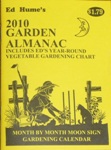
Ed Hume 2010 Garden Almanac

Feng Shui and gardening go hand in hand.  Those who practice Feng Shui can learn most of the core concepts simply through the study of nature and its patterns.  Some examples of these patterns include the seasons, movements of the planets, source and course of water, and phases of the moon.  Through understanding the patterns of nature you can begin to see the complex interrelationships which to the uneducated observer can appear to be magical manifestations of an unknown catalyst. One gardener may perform the same actions as another and yet they do not achieve the same results – only one has what we call a “green thumb”.  Why?

The more we can perceive the patterns and identify the relationships, the more we can influence the outcome of our endeavors.  Suddenly everything is easier because we understand how to act at the proper time, and to understand when we are trying to work against the resistance of nature.  The objective is the same for gardeners and Feng Shui practitioners:  to observe and understand the patterns of nature and act in a way that maximizes our achievements rather than our endeavors.

The phases of the moon have a physical and measurable effect on the earth.  One of the most obvious manifestations of the influence of the moon would be the tides.  The gravitational pull of the moon is the strongest at the new moon and the full moon, which is when we see the highest tides.  The moon has the same effect on the moisture in the ground and water that is under the ground.  During the new moon, moisture is pulled up into the soil which causes seeds to swell and sprout more vigorously.  The second quarter of the moon is generally a good time to plant since this phase will support vigorous leaf growth.  During the full moon the moisture content in the ground is the highest and the seeds will absorb it the most.  The third quarter (after the full moon) is a good time for root growth, and planting those root vegetables as the moon wanes and the moisture can sink back down.  In the fourth quarter the gravitational pull is much less which means less vigorous growth.  The fourth phase is the right time to mow your lawn, or pull weeds.  If you do these chores in the fourth phase you will not have to repeat them as often.

Can you still have a lovely, productive, lush and blooming garden if you don’t let the phases of the moon guide your tasks?  Sure, but if you want to be known for having a green thumb you should really try this method.  And who wouldn’t want to do less weeding!  My favorite guide for keeping track of all this stuff is Ed Hume’s Gardening Almanac.  It is a short, straightforward list of tasks and the optimal dates for performing them.  All that for only $1.79!

Feng Shui for Gardeners 2010

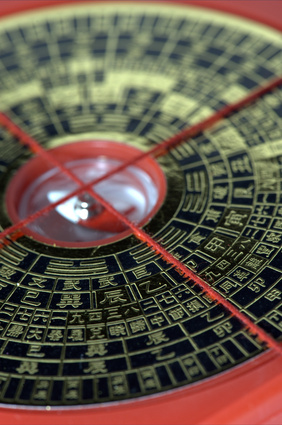
Chinese Compass

On February 4th, 2010 we will begin the Year of the Metal Tiger. This means that in Chinese Astrology the Year God (or Tai Sui) will be the Tiger. Those born in the year of the Tiger should be cautious as they will be receiving the biggest and strongest portion of the energy of the year. Imagine all of the twelve animals of the Chinese Zodiac seated around a big round table for a feast (just like a Chinese Feng Shui Compass). The Tiger will get the first, biggest serving of everything that there is to offer this year. So if this is year of peace, the Tiger will have the first, biggest serving of peace. If it is a year of conflict, the Tiger will have the first, biggest serving of conflict. The animal directly opposite the Tiger at the table (or on the compass) is called the Sui Po. For 2010 the Sui Po is the Monkey. Because the Monkey is opposite the Tai Sui he is in a dangerous position. You don’t want to be in opposition to the God who is in charge for the year. Other compass areas are affected by the Tai Sui as well. For 2010 those areas cover most of the north (including NW and NE) and the southwest.

So why should you care? If you want to practice Feng Shui you will avoid disturbing the north and southwest areas of your lot. If you are a gardener this is not the year for you to put that irrigation system in the southwest of the lot. Keep it clean, weeded, and quiet but no digging. Bad luck will follow if you disturb those sleeping gods.  They say that those who do the actual work will get the worst effect so if you hire someone else to do the work it will affect them and you, too.

One of the reasons that I enjoy Feng shui so much is that there are almost always common sense reasons to follow the recommendations.  What I mean is we can understand the premises of astrology, physics or biology behind the Feng Shui advice, but there is almost always a more tangible and mundane aspect that applies as well.  It’s really not a bad idea to let some of the areas of your garden “rest” each year.  You can only do so much work anyhow.

Camellia Sasanqua “Yuletide”

When I first moved to the PNW I thought of camellias as plants for old ladies’ gardens.  To me the camellias were background for the other more important and flashier plants.  This is my 20th winter in the PNW and I have learned my lesson.  Winter blooming plants and evergreens are some of the most important plants in my garden as far as I am concerned.  Seeing the cheery red and yellow blooms of Camellia sasanqua “Yuletide” this December as I leave and return to my house has lifted my spirits much more than I would have thought possible.

One of the core theories of Feng Shui, no matter what method you practice, is that the small things in your life add up to make it what it is today.  Even things that you might not think of as being important have an effect on you.  The accumulation of these small things can sneak up on you, slowly and subtly changing your qi before you even realize it.  Feng Shui practitioners work to help you change your environment so that the combined effect of the small things makes you feel optimistic, strong and vibrant.  One of my Feng Shui teachers once told me “If you can’t figure out any way to cure the problem, just make it as beautiful as possible”.  And she was right, it does have an effect, even if it’s not a true Feng Shui adjustment.

If you are feeling like your energy is lower than usual, take a good look at the rooms and places where you spend the most time.  Is there enough light?   Is there enough color and warmth?  Do you have any live plants or pets?  All of these small things will add up over time to influence you, so take some time in this New Year to make sure they are things that lift your spirits.  Even if all you do is clean thoroughly and get rid of some old things you don’t use or want any more I guarantee it will make a difference.